
VIEW
january 2026

// Video Solutions
What’s the Buzz About Security Trailers?
Security trailers have seemingly exploded on the scene lately. Providers and integrators explain the ins and outs of what goes into them, who uses them and how you can get started selling them.
By Karyn Hodgson, SDM Editor
Reasons for trailers are as varied as the technologies they can include. Retail is a growing vertical to promote customer safety. Image courtesy of Security 101

Security 101 fully customizes its trailers for customers, including their preferred camera and NVR providers. Image courtesy of Security 101
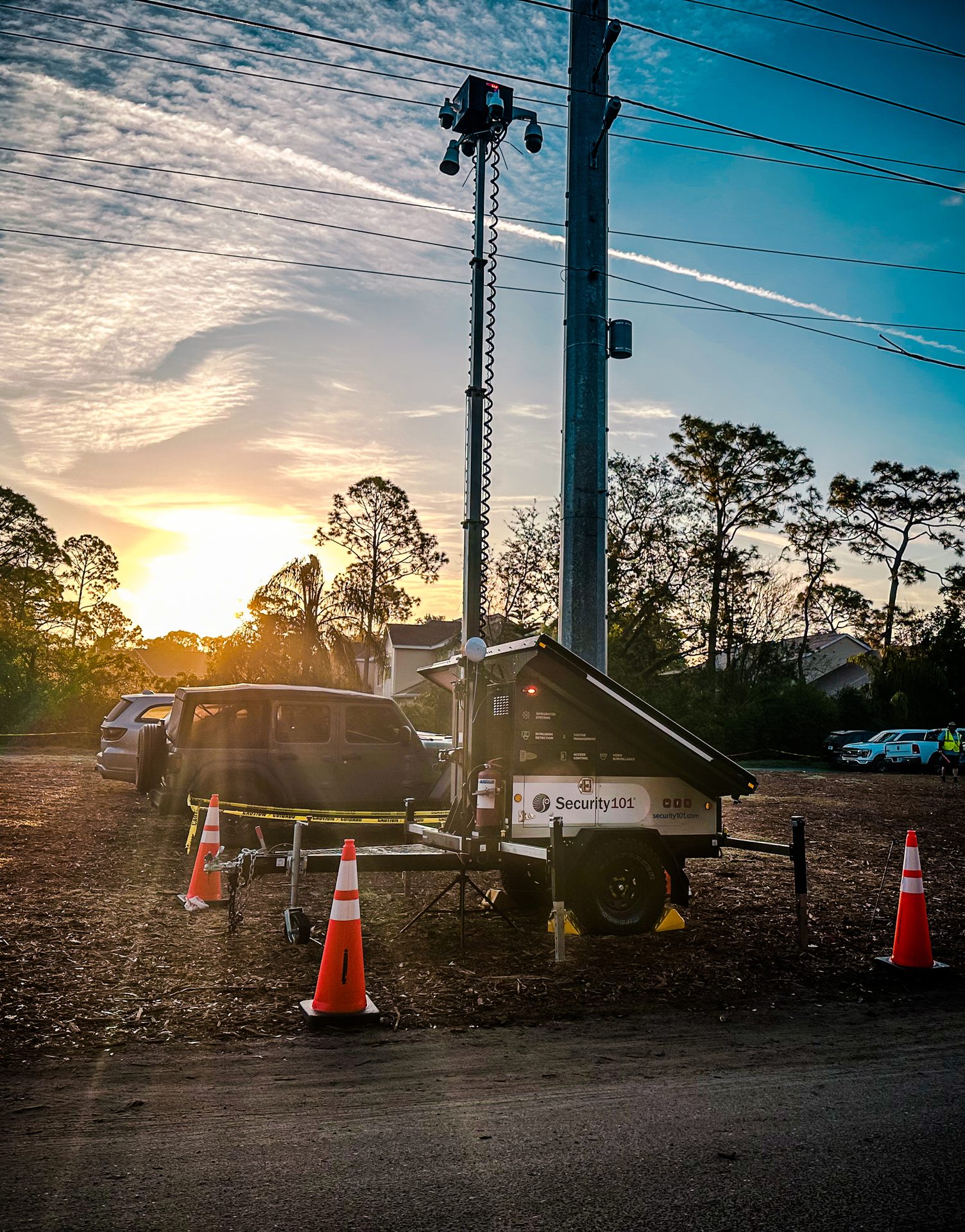
Reasons for trailers are as varied as the technologies they can include. Retail is a growing vertical to promote customer safety. Image courtesy of Security 101
SHARE
Stand in the middle of any security industry trade show recently and look around. Chances are, you will see one, two or even three tall “poles” with lights, video cameras and other technology within your sightline. Security trailers have arrived in force, and there are a multitude of options out there for the integrator who wants to start offering this hot commodity. But it can be difficult to pinpoint where to start.
“There is a lot of buzz around trailers,” says Ken Poole, chief revenue officer, Security 101, West Palm Beach, Fla., noting they started the process over a year ago. “We were receiving calls from clientele and prospects,” he recalls. “We didn’t have any trailers at that time. There are many partners to resell, but we were excited by it, so we acquired a company out of Flint, Mich. One of the many attractions was they built their own trailers.”
Stone Security, Salt Lake City, chose the path of developing their own trailers, starting about a decade ago as one-off solutions for customers who asked for them. However, it wasn’t until just a few years ago that it became a more viable option to produce and sell to a wider variety of customers — coinciding with an increase in interest from end users. “Cloud made them a lot more available from a price and ease-of-use perspective,” says Andy Schreyer, vice president of security technology and marketing, Stone Security.
Poole also attributes the increase in customer interest to technology advancements. “The cost of data has come down. You can now, for about $100 a month, get unlimited data, where, three years ago, that was not the case,” he says. “But the real catalyst for this is the implementation of AI in the cameras. There is a lot you can do with AI embedded in the cameras. Before, it was all server-based.”
Poole also points to fuel-cell batteries’ influence on the market: “Now you can put them in a remote area without power. … Advancements in multiple technologies have made trailers a cost-effective solution.”
Dean Cunningham, segment development manager, public safety, Axis Communications, Chelmsford, Mass., adds, “Mobile surveillance units and trailers are an effective way to deploy standardized security packages to remote or temporary locations. They have grown in popularity over the last decade as power supplies, such as batteries and solar, have matured to better handle the demands of security technologies. This growth has also been driven by the maturing of network-based devices, edge processing and integrated analytics.”
Along with increased interest and availability of advanced technologies, a number of companies have developed packaged solutions to resell, with one of the best-known being LiveView Technologies (LVT), American Fork, Utah. “Our solution is designed as a fully mobile security platform that can be easily repositioned to meet a customer’s evolving security needs,” says Matt Kelley, senior vice president of business and market development, LVT. “The real value is the unit’s ability to be relocated instantly, moving wherever and whenever the customer needs immediate coverage, which is a major benefit for dynamic environments like construction sites. This packaged approach, which security integrators have embraced, really started to accelerate in the mid-to-late 2010s when advancements in reliable 4G/5G connectivity and cloud AI finally made professional-grade mobile surveillance both practical and scalable.”
“Mobile surveillance units and trailers are an effective way to deploy standardized security packages to remote or temporary locations. They have grown in popularity over the last decade as power supplies, such as batteries and solar, have matured to better handle the demands of security technologies. This growth has also been driven by the maturing of network-based devices, edge processing and integrated analytics.”
— Dean Cunningham, Axis Communications
Colleges and universities are a growing vertical for trailers, particularly for events on campus. Image courtesy of Stone Security

Trailers such as this one at a city building bring high-end integrated security technology to places that were never practical before, bringing the same level of visibility and control as a permanent system. Image courtesy of Stone Security

DIY or Prefab? Getting Into Trailers
One of the first things to consider when getting involved in the trailer business is whether to develop your own solution or go with one of the growing number of purpose-designed solutions in the market. Luckily, with all of the options available, it is a relatively low barrier to entry for integrators.
Perhaps the easiest way to do it is to work with companies that sell security trailers already designed and ready to buy or lease. “Our platform is currently extremely popular with security integrators because it helps them solve tough customer challenges immediately,” Kelley says. “Integrators are implementing us in two main ways. First, as a deployed AI solution to fill security gaps in places where fixed cameras just aren’t practical or are too costly, like vast parking lots or remote construction sites. Second, they are using us as an easy integration tool. Through our open APIs, they can easily tie our mobile security units right into their clients’ existing security software and monitoring systems.”
This type of option is often a pass-through solution for the integrator, allowing them to rent or lease the solution to customers without the hassle of designing or maintaining them themselves.
“The trend toward pre-packaged or ready-to-deploy mobile solutions emerged as customers and integrators sought faster, more predictable ways to address uses cases like construction sites, critical infrastructure, public events and emergency response,” Cunningham says. “As these needs expanded, manufacturers and partners began standardizing components and workflows to make deployments more scalable while maintaining customization.”
Axis doesn’t have its own mobile solution but works with both pre-packaged providers and integrators who want to develop their own trailer solutions.
“Many mid- to large-size integrators are offering their own versions to customers,” Cunningham notes. “They are being implemented as branded trailer lines, rapid deployment kits, pole-mounted packages and even solar-powered mobile boxes, depending on the customer’s needs. Plus, there are a variety of deployment options. They can be purchased directly by the customer; standardized units can be rented or leased; and some integrators even bundle them as a monitoring or response service, offering different revenue possibilities.”
Another option is kits that can be placed on a trailer of your choice, says Hans Kahler, chief operating officer, Eagle Eye, Austin, Texas. “The Eagle Eye Cabinet Systems are preconfigured cabinets that are suitable for any outdoor locations, including remote or hard-to-wire areas without power or internet,” he says. “They’re pre-assembled kits that come with everything a reseller needs to install it on a pole, a trailer, on the side of a building or other outdoor locations.
“Several years ago, we noticed our resellers taking the initiative to assemble their own cabinet systems,” Kahler adds. “It was a great idea, but it was time consuming for them to source the components, build the cabinets, then maintain and support all of the disparate parts. We saw this trend happening and decided to develop a suite of all-in-one cabinet systems that are simple to install and support and provide additional recurring revenue for the reseller.”
The final option is to do it in-house. Some integrators took this path out of necessity, such as Pro-Vigil, San Antonio, Texas. “We began developing mobile surveillance units in late 2006 and put the first trailer in the field around mid-2007 after a lot of trial and error and learning how to manufacture something reliable at scale,” says Jeremy White, the company’s founder. “The driver wasn’t that we wanted to build trailers as a business in themselves; they were a necessity to deliver remote video monitoring on construction sites, which were (and still are) prime targets for theft but rarely have the power or network infrastructure needed. Over time, as video, bandwidth, solar and battery technologies matured, those units evolved from a workaround into one of the most versatile tools we have for putting eyes and ears anywhere they’re needed.”
White adds that, when they started their search, there weren’t any off-the-shelf trailer platforms that matched what they needed. “As the industry has evolved, devices have gotten smaller, power consumption has dropped, and connectivity options have expanded, so we’ve continually upgraded the design rather than locking ourselves into someone else’s view of how a unit should work,” he says.
Stone Security made a similar calculation after their first forays into trailers a decade ago, ultimately choosing to do it themselves at more expense, Schreyer says. The company considered the pre-built subscription model but ultimately decided against going that route. “We don’t want to just resell a subscription where we don’t have that relationship with the customer,” Schreyer says. Instead, the company went all-in on designing their own trailers, with high-end pneumatic masts and a large enough battery capacity to not need a generator.
“The biggest advantage of doing it ourselves is that the trailer reflects the way we think about integration,” Schreyer says. “It’s not just a power source on wheels; it’s a complete system that ties into our broader ecosystem of cameras, analytics and communication technology. That unity is what gives our customers confidence that it will work the way they expect.”
After being acquired by BearCom last year, Stone Security made the business a separate entity in preparation to build a channel to sell to others through Wesco. “We have our own website for it, and have sold some already,” Schreyer says. “We made it its own entity with its own branding. If we are going to sell them and do well with them, being a manufacturer is different than being an integrator.”
Security 101’s experience building their own trailers was a similar journey, but one Poole cautions may not be for everyone. “If someone just wants a low-cost trailer and wants to lease it, there are other options out there,” he says. “Our clientele was asking for it, and we didn’t have it. We could have gotten a commercially available one to resell, but that wasn’t what our clientele was looking for.”
Poole adds that the process was fairly complex, particularly since Security 101 took the stance of staying completely open to whatever video camera or VMS the customer wanted to use rather than selecting one to standardize on. “I did not appreciate the amount of work and R&D that needs to go into it,” he says. “When you think about it, a Hanwha camera draws different than an Axis or i-PRO camera. … We have clients that will ask us for a less well-known brand of camera or NVR, and we don’t just say yes. We have to make sure the power will work. … The other thing you have to think about is servicing on the back end. Think about training, maintenance, refilling generators when needed.”
Still, he says there has been a lot of interest in the trailers from customers. “It took a while to get ready for it, but we were super thoughtful about it. We had the ability to assemble them but needed a program to ship them and insure them and register them. It has been a business-within-a-business to get it to this point. We consider it fully launched as of three months ago.”
Pro-Vigil designed their own trailers to deliver remote video monitoring on construction sites, which are prime targets for theft but rarely have the power or network infrastructure needed. Image courtesy of Pro-Vigil
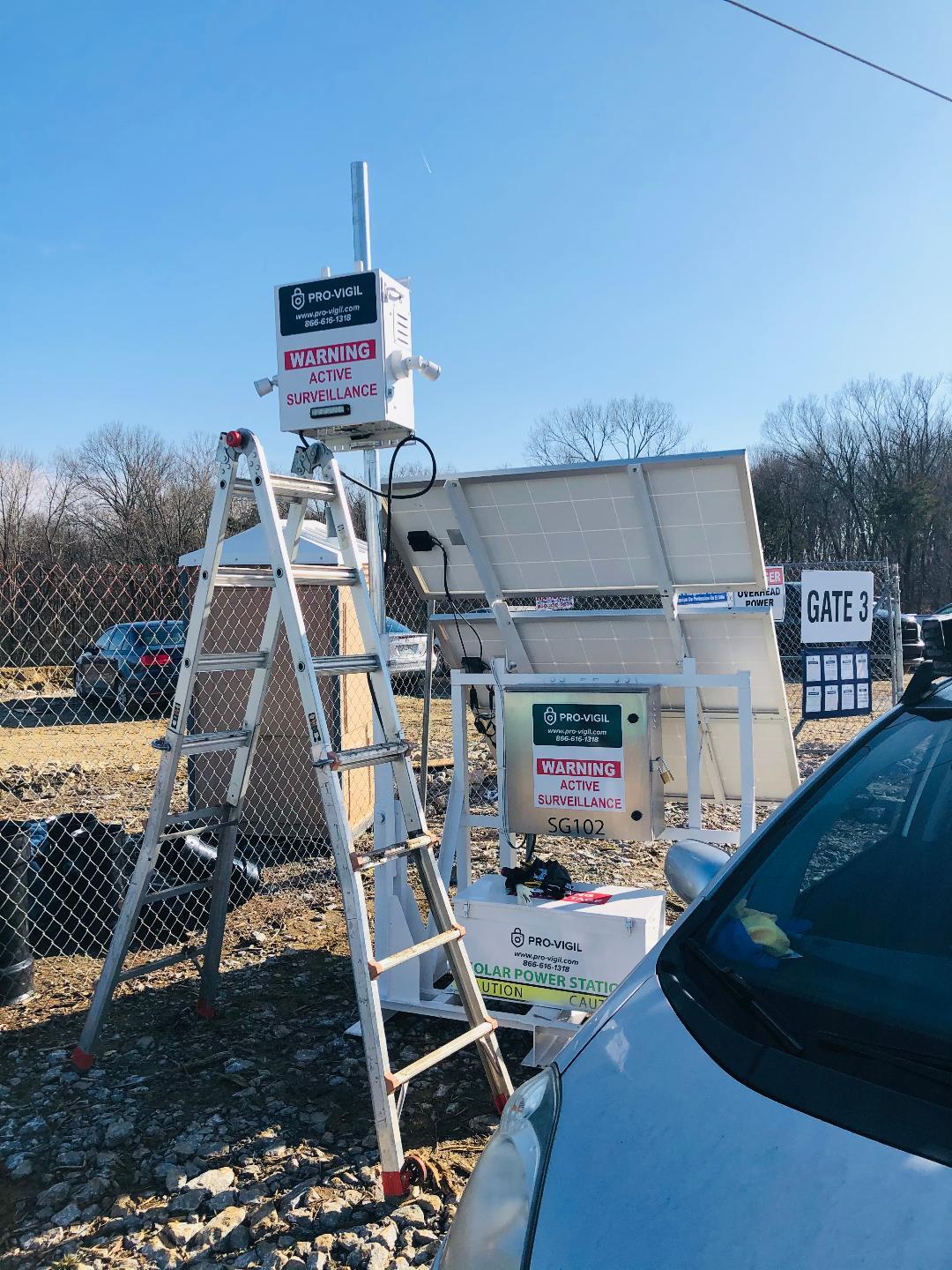
Eagle Eye Cabinet Systems are pre-assembled kits that come with everything a reseller needs to install it on a pole, a trailer, on the side of a building or other outdoor locations. Image courtesy of Eagle Eye

“The biggest advantage of doing it ourselves is that the trailer reflects the way we think about integration. It’s not just a power source on wheels. It’s a complete system that ties into our broader ecosystem of cameras, analytics and communication technology. That unity is what gives our customers confidence that it will work the way they expect.”
— Andy Schreyer, Stone Security
Business Models & RMR Opportunities
There are many ways to make trailers profitable, from designing or buying them outright and leasing them to customers, to a pass-through model where the integrator leases them and marks up the service to the customer.
“For us, these units are 100% a recuring revenue model,” says Jeremy White of Pro-Vigil. “We don’t sell trailers, we deploy services. The business outcome means we can take remote video monitoring into places where it simply wasn’t practical before. … Because we have standardized on cellular and solar, we can roll into a site without power or network and go live quickly, then pull out just as easily when the project is over. That combination of high performance with flexibility for the customer and repeatable redeployment for us is what makes the economics work.”
Hans Kahler describes the Eagle Eye Cabinets as “hands-off” for the reseller. “The whole system is included in one monthly subscription fee,” he says. “If the cabinet is purchased as an Eagle Eye Complete subscription (OpEx), all of the components have lifetime repair and replace guarantees.” Once installed or deployed on a trailer, the cabinets provide recurring revenue, with the amount depending largely on the type of components, he adds.
“For the most part, our LVT units operate on a subscription-based model, eliminating the need for our customers to perform maintenance,” says Matt Kelley of LVT. “This also includes our proprietary video monitoring system. We rarely have additional charges outside of the subscription service,” he explains.
“We generate both project-based and recurring revenue from the trailers,” says Andy Schreyer of Stone Security’s in-house built trailers. “Many customers choose to lease or subscribe to them for seasonal or event-driven use, while others purchase units outright and rely on us for monitoring, maintenance and support. That recurring side of the business has been a welcome outcome, but it wasn’t the original goal.”
Ken Poole of Security 101 says of their trailer offering: “We came up with a leasing program. ... We have some flexibility in our pricing. The longer the customer leases it, the better price we can give them. … It is nice recurring revenue. We don’t push it one way or the other. We are not out there marketing it to everyone. But we see the benefit of doing it for our clientele. It is not a simple add-on, but it does allow the end user to keep that one-stop-shop mentality. We are the easy button for the customer to add trailers.”
Customer Use Cases & Configurations
While trailers may have originated in the construction vertical, today there are a multitude of use cases and verticals that are starting to demand these solutions.
Reasons for trailers are as varied as the technologies they can include, Poole says. “Some of it is deterrence. It is a big thing with flashing lights and voice-down capabilities, some of which are AI-generated now. A customer could be having a problem today in a certain area, but they don’t think it will be a long-term problem. A trailer can be a quick answer. Then, they have the flexibility of moving it or bringing it to another branch. … We used to see them predominantly at construction sites. Now retail is a big one for customer safety.”
Security 101’s standard trailer includes five cameras, including multiple PTZs and a fixed camera looking down at the trailer, Pools says. “We do put servers in our trailers to use whatever VMS a customer wants,” he adds. “It is not only recorded on site but also cloud hosted.” About 70% of their solutions are currently using AI to automate voice-down responses, he says. The company can also customize the trailer to include either Security-101’s or the customer’s own logo.
Schreyer says the reasons for trailer demand varies by vertical. “Universities, for example, have a lot more demand for something temporary because they are fearful of events going wrong like the Charlie Kirk assassination. … They have different needs than municipal clients, which want to cover parks and don’t want to pay money to put permanent infrastructure in place.”
Stone’s trailers include cameras with audio and analytics, Schreyer says. “The biggest opportunity with these units is reach,” he says. “It allows us to bring high-end integrated security technology to places that were never practical before: construction sites, campuses, utilities and remote facilities can now operate with the same level of visibility and control as a permanent system. That reach has opened new conversations with customers who might not have worked with us in the past.”
Eagle Eye cabinets are being installed at car dealerships, retail and school parking lots, school sports fields, municipal parks, city centers, gated communities, warehouses, public spaces, construction sites and other places where expensive inventory or building materials are stored, Kahler says.
“The cabinets can do so much more than record video; they can be used for license plate recognition, opening gates to parking areas, Smart Video Search, 911-Camera Sharing and other AI-powered features,” Kahler adds. “The biggest opportunity is that the cabinets empower security integrators to solve one of their customers’ most common problems — deploying security cameras in remote or hard-to-wire locations in a reliable, economical and cybersecure manner. Our security integrator partners readily recognize this opportunity, as evidenced by the popularity and demand for our cabinet systems.”
Advice for Integrators
While those who deployed mobile surveillance trailers describe it as low or moderate complexity, there are still things to be aware of no matter which way you enter the space. Here are some of the top suggestions from the experts:
“My advice would be to start with the customer’s real need, not the equipment list. Too many people try to build a mobile solution by bolting parts together, but that usually leads to something that only works on paper. The real challenge is power, communication and reliability. If those three elements aren’t solid, it doesn’t matter how good the cameras are. … Treat mobile systems as an extension of your integration, not a side project. They deserve the same engineering discipline and customer care as a permanent installation. When done right, they become one of the most visible and trusted parts of what you offer.” — Andy Schreyer, Stone Security
“As integrators build out their units, they should consider building around open architecture to allow for the flexibility to include add-ons, like analytics, audio deterrence, and intelligence to meet their customer’s unique needs. However, while flexibility is important, they should also look at a standardized base offering to prevent one-off engineering builds. This will also let them prioritize reliability and quick deployment.” — Dean Cunningham, Axis Communications
“My biggest advice is to treat this as a fleet and logistics business, not a one-and-done project sale. You need a clear plan for how many times a unit must be deployed to break even, how you’ll manage geography and relocation, how you’ll maintain and rehab units between jobs, and how sales will keep utilization high in a competitive market. Many integrators are used to bolting equipment to a building and moving on; trailers are different. You’re constantly redeploying, servicing and supporting them. And remember, the unit alone won’t win you business. The real value is the monitoring and customer experience you deliver on top of that hardware.” — Jeremy White, Pro-Vigil
Growing Opportunity
One thing is certain, according to the experts: the trailer trend is not going away any time soon.
“The mobile surveillance industry is still very young, roughly 20 years old or less, and adoption is spreading well beyond construction,” White says. “We’re seeing strong demand in parking lots, retail centers, critical infrastructure, renewable energy sites, large auto dealerships and around data centers supporting AI workloads. Add on the ability to use these units as data collection points for analytics and business intelligence, not just security, and the opportunity grows. There will always be environments where a permanent, fixed video system is overkill or too rigid; mobile units fill that gap, and I only see demand growing.”
Schreyer agrees. “We believe this part of the business will continue to grow,” he says. “The demand for mobile, connected infrastructure keeps increasing as organizations look for ways to extend protection without major construction or long project timelines.”
Both Schreyer and Poole also see the form factor shifting, perhaps smaller than many of the current options. Stone Security now has a “MobileMini” option, which is a smaller profile similar to a skid. “They are growing faster than the trailers. They are a little more permanent, but quick to deploy and much more cost effective,” Schreyer says.
“We are now looking at a smaller footprint trailer with the same if not more capabilities,” Poole says. “I don’t think there is an end to where trailers stop. The use cases are everything from construction sites to healthcare to remote sites in the woods.” He also says his company is looking at building trailers capable of moving at 70mph on a highway to extend their reach.
Technology options are also advancing, says Ben Shaw, president of Shaw360, Louisville, Ky. “[We] entered the mobile security unit (MSU) market five years ago to enhance our manned guarding operations and showcase true integrated security with technology,” Shaw says. “In 2025, we partnered with Flex Security for MSUs for several reasons, the most significant being the innovation they bring to the table. ... They provide a comprehensive Video Management System (VMS). Flex Security has also set a new standard by incorporating an entirely autonomous drone into their MSU offerings,” he adds.
“It’s hard to think of an industry that couldn’t benefit from mobile surveillance,” Cunningham says. “While not needed in every situation, they can be used at construction sites, to secure critical infrastructure and utilities, for public safety and real time crime center (RTCC) deployments and for disaster response, to name a few of the more obvious examples.
“Many mid-to-large integrators already have their own mobile surveillance offerings, and as these units continue to grow in popularity, opportunities will continue to rise,” Cunninham adds. “By entering the market, if they haven’t already, integrators will have the opportunity to make a real difference for their customers while growing their business with additional recurring revenue.”
SHARE
