
july 2026 // sdmmag.com
// SDM Exclusive
SDM’s 2026 Top Systems Integrators Find Their Lane
In a market defined by AI, convergence and economic pressures, the industry’s leading security integrators are demonstrating that specialization is a path to growth.
By Karyn Hodgson, SDM Editor

Like their SDM 100 counterparts, the 2026 top 100 security integrators, as ranked by their North American security integration project revenue, navigated a rocky 2025 by leaning on vendor relationships, internal strategies and discipline to stay on track. But even more than that, this group found success by honing their strengths — whether in specific vertical markets, or by refining certain technology offerings.
By all accounts, these strategies paid off. Their aggregate total systems integration revenue rose by double digits for the second year in a row to $9.72 billion, up another 15 percentage points after last year’s 18 percentage point gain.
“The physical security integration market continued to show steady expansion in 2025, with overall industry growth generally expected to land in the low double digits, driven by increased investment in access control, video systems and integrated enterprise security platforms,” wrote No. 8, Security 101. “We experienced consistent demand across our core verticals and saw no meaningful disruption from broader macroeconomic pressures. While tariffs and supply chain concerns continued to impact portions of the technology sector, Security 101 successfully managed these dynamics through strong vendor relationships, disciplined pricing and operational planning.”
No. 14, Unlimited Technology Inc., found the 2025 market to be strong, but a bit rocky. “The first half was uneven as organizations worked through lingering economic caution, but the second half accelerated meaningfully as interest rates began to ease and procurement timelines compressed,” the company wrote. “Customers who had delayed capital projects came back to the table with urgency. … Tariffs created early pricing pressure that required close coordination with manufacturing partners, but we managed to get through it without significant disruption to project delivery. Inflation and labor costs remained factors we planned around rather than reacted to.”
Despite overall project revenue being up, however, profit margins were squeezed by some of these same factors.
“The market for security systems sales and integrated systems projects in 2025 was strong compared to 2024,” wrote No. 21, LVC Companies Inc. “On the downside, we experienced some margin erosion due to ongoing supply chain issues, labor rate increases and inflation holding back spending in some sectors.”
No. 82, Valley Alarm, also mentioned this: “Margins were down slightly in 2025 compared to 2024. Tariffs and inflation impacted margins due to price increases between the time of proposal and the time of install. Increased labor costs also impacted margins.”
This is reflected in the aggregate numbers as well, with just over half (53%), noting that their company’s net profit margin increased in 2025, after two years in a row at or above 60%. However, the corresponding rise in those reporting that profit margins stayed the same (31% vs 18% last year) shows more of a holding steady pattern than a true decline.
In the comments, a few main themes emerged as the key to these integrators’ successes. AI was, of course, prominent both for 2025 and even more so when asked about the biggest factors that will impact 2026 and beyond. Another trend that bolstered business was the rise in demand for integrated security and business intelligence. A common denominator was how many noted specializing in certain verticals, technologies or services.
Read on to learn more about how these top companies found their path to success this year.
“Organizations are increasingly looking for solutions that deliver not only protection but also operational intelligence and scalability across multiple locations.”
— Prosegur Security Integration
Total North American revenue from systems integration for the 100 largest security integrators grew 15 percentage points to $9.72 billion over last year’s report of $8.40 billion, continuing a multi-year growth pattern. This number represents revenue from solutions such as design, project management, product, installation, programming, start-up and training sold directly to an end-user customer or through a tier of contractors. It does not include recurring revenue from services and monitoring, as integrators were asked to report that amount separately. This growth comes in spite of declines in the numbers of new systems, total full-time employees and business locations.
North American systems integration revenue (as reported to or estimated by SDM) once again topped its highest number in a decade. This amount reflects another double digit percent increase (15%) over the 2025 report. (Note: It is important to read the footnotes above when referencing the results of each year because the addition or removal of a large security integrator can have a major effect on total revenue.)
Top Drivers & Constraints in 2025
Many security integrators typically deal with large commercial customers, who increasingly saw value in security-related systems in 2025.
Don Young, CEO, Everon, ranked No. 3, shared: “There’s a shift in viewing security more as a strategic investment rather than a defense expense. As threats become more sophisticated and infrastructure becomes more interconnected, our role is to deliver integrated, scalable solutions that help customers safeguard essential systems while enabling smarter, more efficient operations across organizations.”
No. 52, Prosegur Security Integration, wrote: “Physical and electronic security continues to be viewed as a mission-critical function rather than a discretionary expense. The strongest growth segments were AI-driven video analytics, cloud-based access control and integrated security platforms. Organizations are increasingly looking for solutions that deliver not only protection but also operational intelligence and scalability across multiple locations.”
No. 85, Silent Guard, noted: “We saw continued momentum across the commercial segment, particularly in fully integrated solutions that combine access control, video surveillance, intrusion detection and life safety. End users are increasingly prioritizing efficiency, risk mitigation and operational visibility — not just basic security. … As labor, insurance and operating costs continue to rise, businesses are investing in technology that saves time, reduces liability and provides actionable data. That trend worked in our favor. Commercial integration projects showed the strongest growth for us in 2025.”
Access control, fire protection and video monitoring were particularly strong technology plays for other companies as well, such as No. 19, Zeus Fire and Security. “Customer demand for high-quality system installation, ongoing and monitoring solutions that meet both code compliance and evolving business requirements remained resilient throughout the year,” the company wrote.
“Compared with 2024, the market for security systems sales and integrated systems projects in 2025 was strong, with continued demand for both new installations and modernization of existing systems,” wrote No. 24, Integrated Protection Services (IPS). “Growth was led by commercial and enterprise customers investing in access control, video and integrated life safety solutions, particularly projects that emphasized system convergence, scalability and long-term service value. Mission-critical, data-driven and multi-site environments performed especially well.”
While many integrators reported the market was strong overall, there were still economic headwinds to deal with.
“Elevated interest rates and persistent inflation required customers to be more deliberate in capital spending decisions, lengthening some sales cycles, while tariffs and supply chain volatility continued to influence equipment costs and lead times,” IPS continued. “IPS mitigated these impacts through early procurement planning, strong vendor partnerships and a growing focus on higher-value projects and recurring revenue models, allowing us to remain resilient and competitive throughout 2025.”
Others took a different approach. “Tariffs had a significant impact on our sales operations,” wrote No. 62, Chimera Integrations. “Pricing fluctuations made it difficult to provide consistent and reliable quotes to customers, and, in some cases, pricing was hard to remain competitive. As a result, we made a strategic shift toward manufacturers that produce products in the United States.”
No. 26, Cook Solutions Group, found that most commercial customers understood tariff costs as a necessary pass-through and instead focused on the value. “Ultimately, 2025 was a strong year for security, especially for our managed services and network operations center, which utilizes AI and analytics,” the company wrote. “In addition to integrations and installation projects, our service and managed services grew by double digits, and the need to push remote security patches to protect against cyberattacks also increased. Plus, with cloud access control and edge cameras, we found we are making businesses much more efficient and saving the money using more advanced technologies.”
No 28, Parallel Technologies, summed up 2025 this way: “In 2025, the market for security systems sales and integrated security projects was strong overall, and more ‘results-driven’ than 2024. End users continued to invest in modernizing and unifying video surveillance and access control to reduce complexity, standardize operations and improve response. … Inflation and tariff-related cost pressure influenced hardware pricing and procurement timing, increasing the value of experienced integrators who can scope accurately, standardize solutions and deliver predictable outcomes.”
“It’s no question that data centers remain one of the most dynamic and fast expanding market segments. The exponential acceleration of AI adoption is reshaping requirements for physical and digital security, driving demand for highly sophisticated integrated systems at these sites.”
— Don Young, Everon
The percentage of security integrators who saw their 2025 net profit increase in relation to 2024 dipped by 8 percentage over last year. However, when you factor the stay the same responses for last year and this year, profits are holding steady, with just 16% reporting a decrease. Of those who reported an increase, the average increase was 10 percent, when you take out those who reported a more than 100 percent increase. Of those who reported a decrease, the average was 4 percent.
The number of responses predicting a strong 2026 fell by 5 percentage points after last year’s 10 percentage point jump, but is still a healthy 83%. Of those anticipating an increase, they expect an average of 16% increase over 2025 revenues, up from last year’s 15% prediction.
The Vertical & Technology Specialists
Beyond the noted trend of customers wanting more business intelligence out of their security systems, another strategy these top integrators employed was specialization.
Probably the most mentioned vertical market opportunities revolved around data centers. “It’s no question that data centers remain one of the most dynamic and fast expanding market segments,” Everon’s Don Young wrote. “The exponential acceleration of AI adoption is reshaping requirements for physical and digital security, driving demand for highly sophisticated integrated systems at these sites.”
No. 66, NewVision Security LLC, wrote, “Our company’s most significant accomplishment in 2025 was our successful entry into the data center market, specifically through fire system integration projects. This marked an important strategic expansion into a highly specialized and growing segment of the industry.”
Additionally, No. 15, NextGen Security LLC, noted, “Bigger than AI technology itself is the opportunity for securing large AI data centers.”
Others were more technology specialists, such as No. 9, CBX Solutions LLC (formerly Cook and Boardman Security Integration). “We experienced a significant increase in merging the two sides of our business: electronic security solutions and commercial doors, door frames and door hardware,” the company wrote. “By doing so, we were able to create a total opening package for our customers and grow into additional markets with customers we historically had limited success with.”
No. 16, ORR Protection, launched two software platforms aimed at the fire space. “This marks ORR Protection’s first investment in proprietary software development and its official entry into digital fire protection solutions for modular and containerized applications, including data centers and battery energy storage systems (BESS),” the company wrote. “Demand for fire protection systems in data centers, BESS, telecommunications infrastructure and power generation is expected to remain strong as AI-driven computing, electrification and digital infrastructure continue to expand. These environments carry unique fire risks and require highly specialized detection and suppression solutions.”
In a similar vein, No. 51, ECC, focused on its specialty area of correctional facilities, with its non-proprietary IMPERIUM solution. “The correctional and law enforcement segment continues to be our strongest growing market for security solutions, as ECC’s IMPERIUM Correctional Control System continues to grow momentum,” the company wrote.
Other growth opportunities mentioned included mobile surveillance trailers — “We increased our mobile surveillance trailers by 67% and increased our RMR,” wrote No. 36, Dallas Security Systems Inc. & DSS Fire — and video monitoring solutions.
“Customers are increasingly looking for outcomes, not devices, and our expanded video services reflect that shift, delivering higher value while creating long-term recurring revenue opportunities,” wrote No. 63, Custom Alarm. “This evolution positions Custom Alarm to lead as the industry continues to converge physical security, AI and managed services, and it reinforces our commitment to helping customers stay ahead of risk in an increasingly complex security environment.”
No. 89, KMT Systems Inc., also mentioned video monitoring as a key specialization. “Our most significant accomplishment in 2025 was the advancement and scaling of our proprietary video solution, OnWatch,” the company wrote. “It continues to be the largest contributor to RMR growth across our organization and has become a core driver of our long-term strategy. This year, we invested heavily in strengthening every layer of the platform. … The result is a fully deployable, AI-driven video solution built for mass adoption and one that positions us competitively in a rapidly evolving market and fuels sustainable recurring revenue growth.”
“AI is changing how customers think about detection, monitoring, response and the overall value of their systems. For integrators, that means a major opportunity, but also a responsibility to help customers apply AI in practical, meaningful ways.”
— Security 101
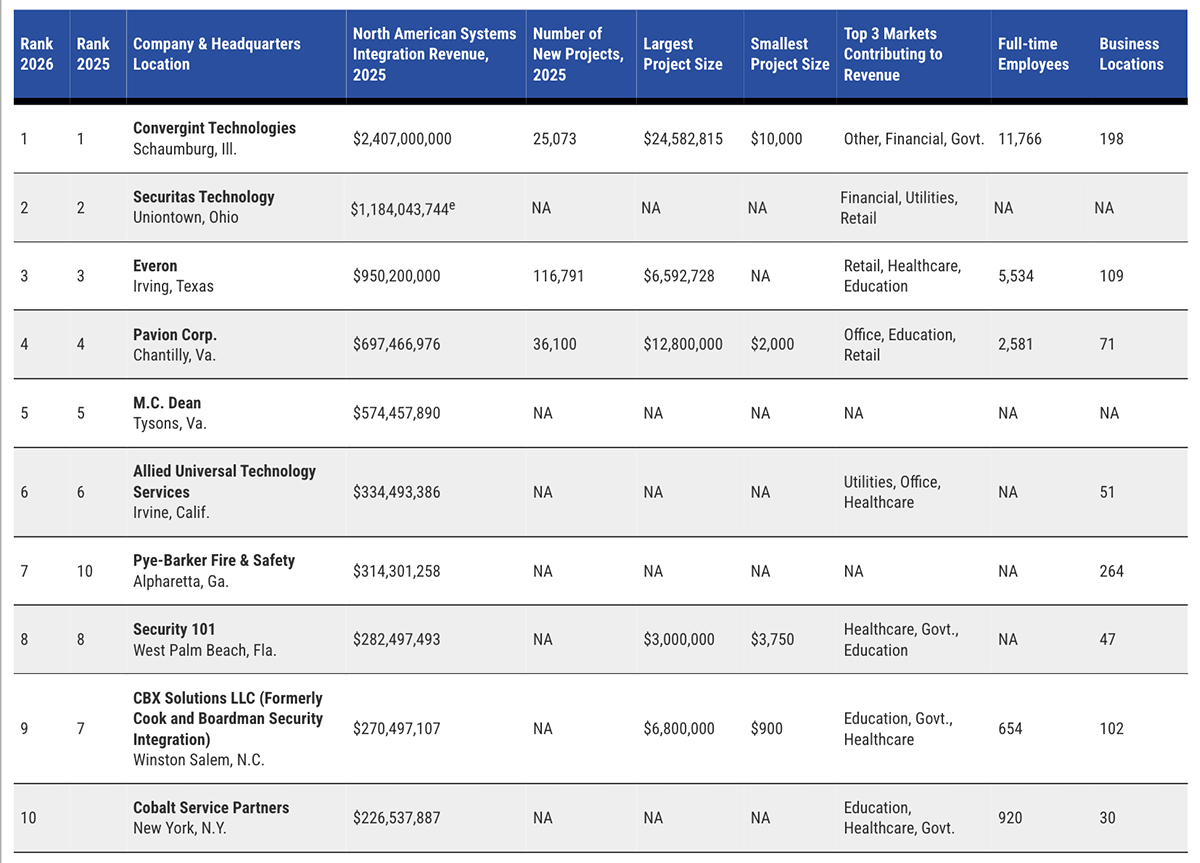
Among companies ranked on the Top Systems Integrators Report, these businesses reported the highest total revenue in 2026. Six companies grossed in the billions.
Growth Models for the Future
Looking ahead to the rest of 2026 and beyond, No. 17, Stone Security, a BearCom company, put the thoughts of the vast majority very succinctly: “AI. That is THE trend.”
Security 101 wrote, “Artificial intelligence will have one of the biggest impacts on our business in 2026, because it is already reshaping the security industry in a very real way. AI is changing how customers think about detection, monitoring, response and the overall value of their systems. For integrators, that means a major opportunity, but also a responsibility to help customers apply AI in practical, meaningful ways. We believe it should remain a major focus for the industry, because its influence is only growing.”
AI is reshaping the market in multiple ways. One of those is by moving solutions from reactive to proactive.
“Advanced analytics are shaping the industry as users are looking to their technology to move from ‘recording what happened,’ to ‘forecasting what might happen’ using historical data,” wrote No. 30, Vision Technologies. “AI is also impacting the business as we work with security partners who integrate AI into their cameras and monitoring systems. Our focus is on integrating these ‘smart’ ecosystems to help clients manage the rising complexity.”
No. 29, Beacon Communications LLC, commented, “In 2026, we anticipate expanded adoption of AI-driven capabilities among our mission-critical clients, including real-time threat detection, predictive analytics and automated response solutions. As staffing shortages continue to impact operations across industries, organizations are increasingly turning to technology, mobile response strategies and automation to drive efficiency and maintain high levels of security performance.”
This same trend is also pushing customers to be more interested in service-based solutions. “The industry is being pushed away from traditional, hardware-centric, reactive solutions and toward proactive, intelligence-driven, service-oriented models that deliver continuous value rather than one-time installations,” ECC wrote.
While AI is certainly the biggest thing on the horizon, it is not the only issue capable of impacting business in the coming year.
“In 2026, our business will be most impacted by rapid advances in AI; an intensifying cybersecurity landscape that will also force integrators and technology manufacturers to achieve SOC2 compliance, at a minimum; rising power consumption demands tied to compute-heavy systems; and ongoing political uncertainty that affects regulations, supply chains and customer confidence,” wrote No. 23, Preferred Technologies LLC.
“In 2026, several issues and trends are likely to have a major impact on the security integration business,” wrote No. 35, Advanced Electronic Solutions. “Economic uncertainty could influence clients’ willingness to invest in projects and affect equipment costs. At the same time, cybersecurity threats and the growing use of AI in security systems will drive demand for integrated, intelligent solutions, while also requiring ongoing training and vigilance to prevent vulnerabilities.”
No. 48, TRL Systems Inc. wrote, “The greatest impacts to our business in 2026 we believe will really be in three areas: the economy, tariffs and the big one, artificial intelligence. In the security industry, it seems, in past years, that the economy has always had an impact; but, now, as part of that, we will have to contend with the possibility of increased costs due to more tariffs. In 2025, we were very fortunate that we were not hit with a tremendous dollar amount of tariffs. Regarding AI, where that is going to take our industry is still up in the air.”
Perhaps biggest lesson these top integrators have to impart on dealing with challenges amidst massive and rapid change is to adapt.
“We are all-in on utilizing AI and analytics to provide security and service,” wrote Cook Solutions Group. “Beyond the hardware, we invest in AI and software solutions that our customers can utilize to make their lives easier, more efficient and productive. Companies that stay up with innovation like CSG typically navigate issues effectively and are able to deliver solutions on all of the above trends. We are embracing change and adapting quickly both in the cloud and in the field.”
No. 84, Omniveillance, added, “Bottom line, 2026 will continue the shift from traditional security toward intelligent, connected and service-driven platforms. The providers that win will be those who can combine AI, cybersecurity and integration into solutions that deliver not just protection but measurable business value.”
pingingz / Creatas Video+ / Getty Images Plus via Getty Images
About the SDM Top Systems Integrators Report
The SDM 2026 Top Systems Integrators Report ranks companies by their North American security systems integration revenue. This ranking is based on data provided to — or, in a few cases, estimated by — SDM. Ranked companies were asked to submit either an audited or reviewed financial statement, or a copy of their income tax return showing total gross receipts for the stated period. The vast majority of the firms ranked are privately held.
The main table ranks 100 companies by their North American revenue in 2025 from their security system integration projects. Integration includes solutions such as design, project management, product, installation, programming, start-up, training and time-and-materials-based service sold directly to an end-user customer or through a tier of contractors. This includes revenue related to security, such as access control, ID/badging, video surveillance/analytics, intrusion alarms, perimeter security, electronic gate entry, intercom/communications, fire protection, IT/networks, etc. It does not include recurring monthly revenue (RMR), as that is counted towards ranking on the SDM 100. However, due to the increasing focus from security integrators on increasing RMR through managed services, maintenance contracts and more, SDM ranks the Top 25 Top Systems Integrators in a separate table.
Note: an e following the figure indicates it is an SDM estimate.
To find a company by name, use the alphabetical index.
How to Use the 2026 TSI Charts & Tables
The main table ranks 100 companies by their North American systems integration revenue as of Dec. 31, 2025. The company with the highest integration revenue is ranked as No. 1, and so on. For each of the 100 companies, the following information is provided, from left to right:
- Current year rank, which is based on Dec. 31, 2025, North American systems integration revenue.
- Prior year rank (if ranked last year).
- Company name, as used in the marketplace, and headquarters location.
- North American systems integration revenue as of Dec. 31, 2025.
- Number of new projects as of Dec. 31, 2025.
- Largest project size.
- Smallest project size.
- Top three markets contributing to revenue.
- Number of full-time employees.
- Number of business locations, including headquarters.
TSI 2026 companies are then re-ranked by several other criteria, including largest project by revenue and top 25 by RMR.
More charts for this report, as well as an archive of prior year reports, can be found on the SDM website. For questions about the Top Systems Integrators Report or the SDM 100 Report, email Karyn Hodgson, SDM Editor.
Note: An e following the figure indicates it is an SDM estimate.
More From the Report
To gain additional information beyond that published in this issue and online, the complete SDM Top Systems Integrators Report & Database is available in Excel format. Included are mailing addresses, telephone numbers, website URLs, targeted vertical markets, branch office locations and much more. SDM’s Top Systems Integrators Report & Database contains the information needed to target products and services to the systems integration market. It may be ordered by contacting Jacquelyn Bean at 215-939-8967 or by emailing beanj@bnpmedia.com.